Filed Website strategyLength 12 minWords 2,715
How to Write Service Pages for a Facilities Management Company
One page per service line, written from the specification rather than the sales pitch. What each page has to contain, in what order, and why the combined page fails.
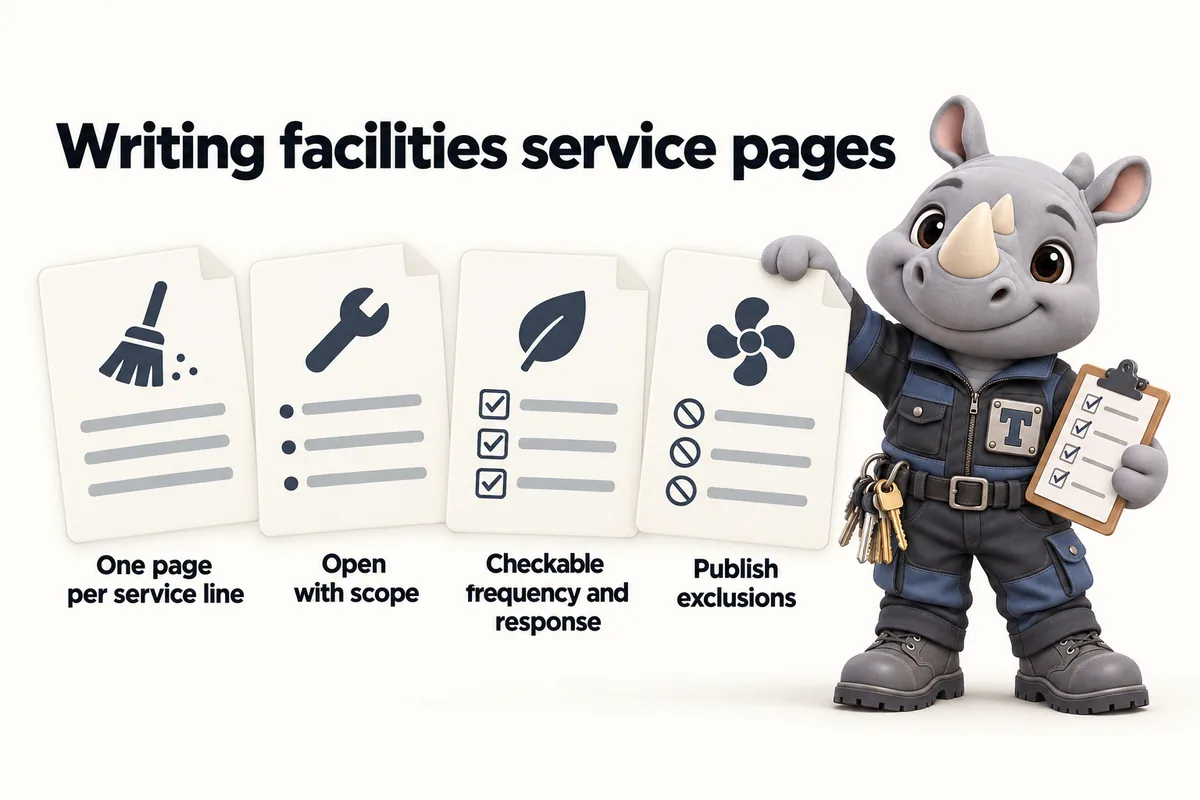
A facilities management company should write one service page per service line, and each page should open with what that service actually covers rather than with who the company is. That is the short answer, and almost everything else in this article follows from it. The combined services page, the one that lists janitorial, hard services, grounds and waste under a single heading with a sentence each, is the most common structural mistake on facilities management websites, and it fails for two independent reasons at the same time: a search engine cannot tell what the page is about, and a procurement reviewer cannot check it against their own scope document.
This is not a theoretical problem. It shows up as the same three symptoms on nearly every site we audit: enquiries that arrive without enough information to quote, search visibility that sits on the company name and nothing else, and a sales process where the first call is spent explaining what the company does rather than discussing whether it fits. All three are the downstream cost of a page that tried to do six jobs.
Why the Combined Services Page Fails
The combined page fails because it has no single subject, and both audiences that read it need one.
Start with the human. A facilities buyer arriving at your site is almost never shopping for “facilities management” in the abstract. They have a building or a portfolio, a budget line, and a specific gap: the cleaning contract is up for renewal, the chiller contractor has stopped answering out of hours, the grounds maintenance is being brought back in from a managing agent. They are looking for the page about that one thing. A combined page gives them a paragraph where they wanted a specification, and they now have to decide whether the missing detail means you do not do the work in enough depth or simply that you did not write it down. Most of them will not ask.
Now take the search engine. Google’s own guidance on creating helpful content describes pages written for people who are looking for a particular thing, with enough depth to satisfy that need. A page that covers six service lines shallowly satisfies nobody’s particular need. It also competes with itself: every query it could match, it matches weakly, and where you have a genuinely strong service line, the combined page dilutes it by surrounding it with five others.
There is a third, quieter failure. A combined page cannot carry correct structured data. Service schema describes one service, with one provider, one area served and one offer catalog. Six services on one page either produce six competing Service objects on a page whose visible content supports none of them properly, or one vague object that describes nothing. On a site where every service page emits its own Service and BreadcrumbList markup, as the services pages here do, the structure and the content agree, and both an evaluator and a crawler get a clean answer.
The Order a Service Page Should Run In
A facilities service page should run in the order a reviewer reads, not the order a brochure is written.
Scope First
The first sentence under the page heading states what the service covers. Not “we have been serving the region since”, not “our dedicated team”, not a definition of facilities management. Scope.
For a janitorial page that means naming the area types you clean and the tasks that belong to each: washrooms, circulation, kitchens and breakout, hard floors, soft floors, glazing, waste streams. For a hard services page it means naming the asset classes: air handling units, fan coil units, chillers, boilers, lifts, fire systems, building management systems. The buyer recognises their own building in that list or they do not, and either answer is useful to both of you within about four seconds.
The instinct to open with the company is strong and it is worth naming why it is wrong here. Credibility on a facilities site is not established by claiming it. It is established by demonstrating that you know the work in the detail the buyer knows it. A list of the right nouns, in the right order, does more for credibility in one line than three paragraphs about commitment to excellence, because the buyer can verify it and they cannot verify commitment.
Frequency and Response Time Second
Immediately under scope, document what your delivery actually commits to. This is the service level ledger idea: a ruled table rather than prose, with the service or area type down one side and the frequency, response time and coverage across the top.
Prose loses this information. A sentence that says “we offer flexible cleaning schedules tailored to your needs” is read by a procurement reviewer as an absence of a commitment, because it is one. A table that says washrooms are serviced twice daily on a standard specification, that a reactive callout is attended within four working hours during core hours, and that out of hours cover runs from a named time to a named time, is checkable. The reviewer can score it, put it beside a competitor, and carry it into a comparison document.
If your commitments genuinely vary by contract, publish the typical commitment and label it as typical. That is still far more useful than nothing, and it is honest. What loses shortlist places is the site that makes a buyer email to find out whether you even work weekends.
Coverage Third
State where the service is delivered, in the terms a buyer uses. For a single-site contractor that is a list of towns or a county. For a regional contractor it is the regions you actually staff, not the regions you would accept work in. For a national provider it is the structure: directly employed teams here, a managed supply chain there, with the difference stated plainly.
Overstating coverage is the single most expensive piece of copy on a facilities site. It generates enquiries you cannot service, which cost time to disqualify, and it damages credibility when a buyer discovers the truth during mobilisation. Understating it costs you enquiries you would have wanted. Getting it exactly right is a matter of writing down what is true, which is harder than it sounds only because nobody usually asks.
Exclusions Fourth
This is the section most facilities companies leave out, and the one that most improves the quality of the enquiries that follow.
Every service has boundaries. A janitorial specification typically excludes specialist deep cleans, external window access above a certain height, and consumables unless separately contracted. A planned maintenance contract typically excludes parts above a threshold, and separates planned from reactive. A grounds contract typically excludes tree surgery requiring a qualified arborist.
Publishing those boundaries does three things at once. It stops unqualified enquiries before they reach your estimators. It reads to a procurement reviewer as the behaviour of a company that runs a documented operation, because only a company that knows its scope can state its exclusions. And it protects the contract later, because a boundary the buyer read on your website before they shortlisted you is not a surprise in month three.
Escalation and Contact Fifth
End with what happens when something goes wrong, because that is what the buyer is quietly assessing the whole way down the page. Who do they call. What is the route when the first call does not resolve it. Is there a named account manager, a portal, a number that reaches a person out of hours. Then give them the way to start a conversation, specific to this service rather than a generic contact form.
Writing Six Pages Without Writing the Same Page Six Times
The legitimate fear about splitting a combined page is that you end up with six near-identical pages, and that fear is well founded. Google’s spam policies describe scaled content abuse as generating many pages with little original value, and pages that differ only by a swapped service name are exactly that pattern. The fix is not to avoid splitting. It is to write each page from its own specification.
In practice that means resisting one particular shortcut: writing a page template and filling in the service name. Instead, write each page from the operational reality of that service, which is genuinely different in every case.
A janitorial page is about frequency and consistency. The buyer’s anxiety is that standards will slip in month four. So the page talks about specification, auditing, supervision, cover for absence, and how a standard is maintained rather than achieved once.
A hard services page is about competence and response. The buyer’s anxiety is that the engineer who turns up will not be qualified for their plant. So the page talks about asset classes, qualifications, parts, planned versus reactive, and out of hours.
A grounds page is about the calendar. The buyer’s anxiety is that the site will look neglected at the wrong moment. So the page talks about the seasonal schedule, the winter service, and what happens in a cold snap.
A waste page is about compliance and documentation. The buyer’s anxiety is a paperwork failure. So the page talks about duty of care documentation, segregation, and reporting.
Four pages, four genuinely different arguments, no template. That is what makes six pages stronger than one rather than six times thinner. The sub-niche pages on this site are built on the same principle: a page for janitorial contractors argues differently from a page for HVAC contractors, because the businesses are different and pretending otherwise helps nobody.
What to Do With the Overview Page
Keep it, and change its job. The services index stops being the place where the services are described and becomes the place where they are routed. Its job is to help a visitor who does not yet know which page they need get to the right one in one click, and to give search engines a clean internal link structure into the six pages below it.
A good overview page carries a short line per service, the one distinguishing fact about each, and a link. It may also carry the things that are genuinely common across all of them and would be repetitive on every page: accreditations, insurance, geographic footprint, how contracts are mobilised. Those belong in one place and get linked from the six.
How This Shows Up in Enquiries
The change that surprises people is not the search traffic. It is the quality of what arrives.
When a buyer lands on a page written for their exact service line, with scope, frequency, coverage and exclusions already answered, the enquiry they send is different in kind. It arrives already qualified: they know what you do, they know you cover them, and they have self-selected out if you do not. The message says what they need and when, rather than asking what you do. The first call becomes a scoping conversation instead of an introduction.
That is the real return on writing six pages properly, and it is why it is worth doing even for a company that gets most of its work through referral. A referred buyer still checks the website before they call. What they find there decides whether they arrive warm or cautious.
Three Questions Every Service Page Should Be Able to Answer Without a Phone Call
A finished service page passes a simple test: a stranger with a live requirement can answer three questions from it alone.
Can you do what I need? This is scope, and it is answered by the nouns. The failure mode is abstraction. “Comprehensive cleaning solutions” is an abstraction; “washrooms, circulation areas, hard floor maintenance, glazing at ground level, and clinical waste segregation” is a scope. A buyer whose building has a commercial kitchen is looking for the word kitchen, and a page that never uses the word has failed them regardless of whether you clean kitchens.
Will you do it as often as I need, and get there fast enough when it goes wrong? This is the ledger. It is the question most often left unanswered on facilities sites, and it is the one that decides shortlists, because it is the only one that can be compared numerically between two suppliers.
Do you already work where I am? This is coverage, and it wants specifics. A map graphic with no place names on it answers nothing. A list of the towns, boroughs or counties you actually staff answers it completely, and it has the side effect of giving you honest, non-duplicated material for regional pages later, if regional pages turn out to be worth building at all.
If a page cannot answer all three, the missing answer is not a copywriting problem. It is usually an internal one: nobody has written the commitment down, or the commitment varies so much that nobody is willing to publish a version of it. That is worth knowing, because it is also what a buyer will eventually run into, just later and more expensively.
What to Measure After the Rewrite
Do not judge a service page rewrite on rankings in the first month. Judge it on the two things that move first.
The first is the shape of the enquiries. Count how many arrive naming the specific service, and how many arrive asking what you do. If the second number is falling, the pages are working, and that will be visible long before any search position moves.
The second is what happens on the page itself. A service page that is being read properly holds attention past the ledger. If visitors are arriving and leaving at the top, the opening is still selling rather than answering, and the fix is usually to delete the first paragraph entirely and promote the second one.
Search visibility follows, and it follows more slowly than anyone wants. Google’s own starter guidance is blunt that useful, well-organised content is the thing that earns visibility rather than any technical trick applied on top of it. Six pages that genuinely answer six different questions are useful in a way one page covering all six cannot be, and the position gains tend to arrive as a step change some weeks later rather than as a steady climb.
A Practical Sequence
If you are rewriting a combined page, do it in this order and do not try to do it all at once.
First, list your service lines honestly, including the ones you would rather not talk about but do deliver. Second, pick the one that makes you the most money or the one you most want more of, and write that page completely: scope, ledger, coverage, exclusions, escalation. Third, publish it and link it from the overview page and from the home page. Fourth, do the next one.
Doing one page properly beats doing six badly, and a site with one excellent janitorial page and a placeholder for the rest is in a better commercial position than a site with six thin ones. The sequence also gives you a working example to argue from internally, which matters more than it should when the operations team has to supply the specification detail the page needs.
Everything above is deliberately independent of who builds the site. If you want it built and maintained for you, that is what we do, and the pricing page says exactly what it costs. If you build it yourself, the structure still holds.
Sources
Frequently asked questions
Should each facilities service have its own page?
Yes. A single page covering janitorial, hard services and grounds maintenance at once cannot answer a specification question about any of them, and it gives a reviewer nothing specific to check against their own scope document.
How long should a facilities management service page be?
Long enough to answer the scope, frequency, coverage, exclusions and escalation questions a buyer will ask, and no longer. In practice that is usually more than a paragraph and less than an essay, and the length follows the answers rather than a word target.
What is the first thing a service page should say?
What the service covers, in the terms the buyer already uses themselves. The opening sentence should answer the heading directly rather than introducing the company, because a reviewer reading four supplier sites in one sitting is scanning for scope, not for a welcome.
Do I have to publish exclusions on a service page?
Publishing exclusions is usually in your interest. A buyer who discovers a boundary during mobilisation treats it as a surprise; a buyer who reads it on your site before shortlisting treats it as a documented scope, and it protects you from scope creep on the contract.
Does splitting one page into several dilute the site?
It does the opposite when each page is written from its own specification. Splitting dilutes a site only when the pages are the same copy with the service name swapped, which is the pattern search engines treat as scaled content abuse.
Want a site like the one described here? Book a demo with FacilityWebStudio.