Filed Content operationsLength 10 minWords 2,300
How Often a Facilities Management Website Should Change
A facilities site does not need a redesign every three years. It needs a small number of pages kept true. Here is what should change, how often, and who should own it.
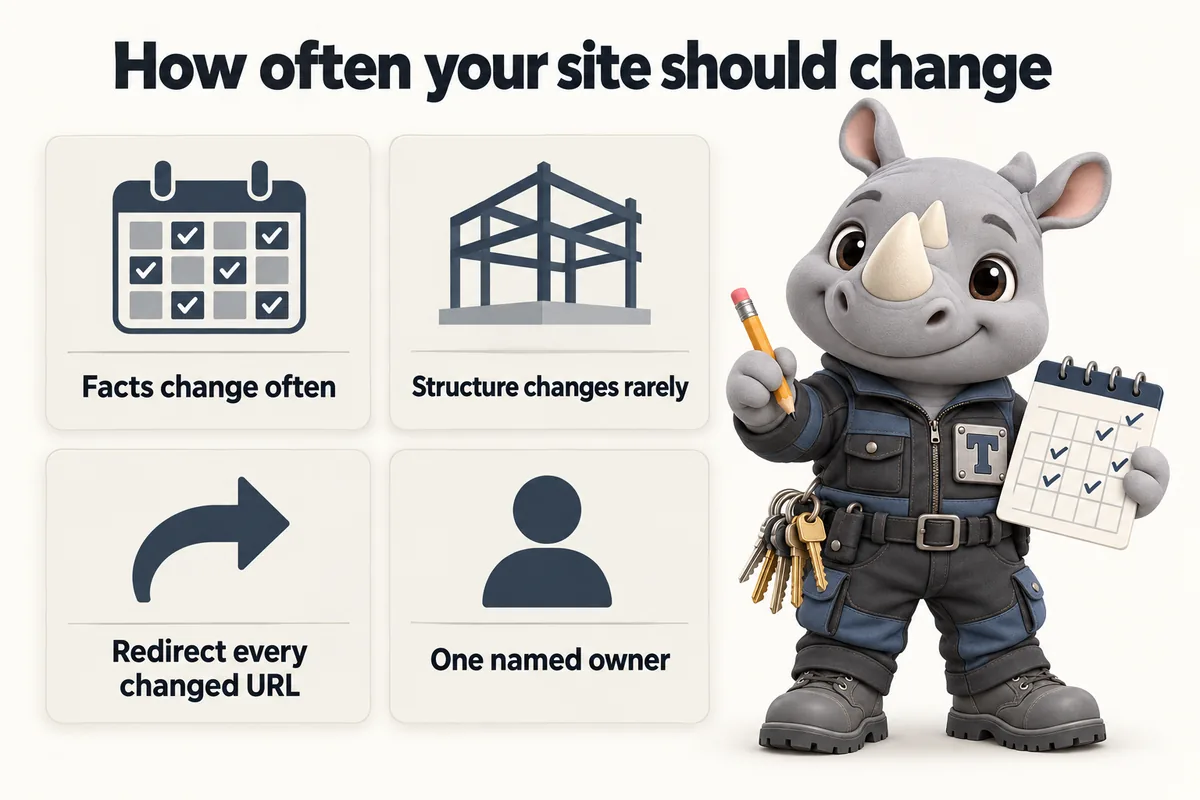
A facilities management website should change in small ways continuously and in large ways rarely. The small changes are the facts: coverage, accreditations, service level commitments, team, insurance. The large change is a restructure, and it is worth doing when the shape of the site no longer matches the shape of the business, not on a calendar.
That is close to the opposite of how most facilities companies operate. The usual pattern is a site that is left alone for three years while slowly drifting out of date, followed by a full redesign that replaces a structure nobody had diagnosed with a different structure nobody has diagnosed either, after which it is left alone for another three years. It is expensive, it is disruptive, and it usually loses whatever search visibility the old site had accumulated.
Two Different Kinds of Change
The confusion in this subject comes from treating “updating the website” as one activity when it is two, with different frequencies, different owners and different risks.
The first is keeping it true. Your insurance renewed and the limit changed. A depot opened. An accreditation lapsed or was gained. A service line was added. A regional manager left. Every one of those makes a specific sentence on a specific page false, and a false sentence on a facilities site is not a cosmetic problem: it is the thing a procurement reviewer catches during due diligence.
The second is changing what the site does. Splitting a combined services page into six. Adding a page for a new market. Restructuring around portfolios because the business has moved up-market. These are structural decisions and they should follow a change in the business, not precede one.
Most companies do neither and then do a redesign, which is an attempt to solve the first problem with the second. It does not work, because a redesigned site with the same stale facts is a stale site with a new typeface.
What Changes Often
The Verifiable Facts
These are the entries a buyer can check, and therefore the ones that cost the most when wrong.
Accreditations and their certificate numbers and expiry dates. Insurance types, limits and renewal months. Registered details and any framework listings. Named contacts and their direct routes. Coverage: which markets, from which base, with what response time. Service level commitments wherever you have published them.
The right cadence for these is not monthly or annually; it is event-driven with a periodic backstop. When the insurance renews, the page changes that week. When a depot opens, the page changes that week. And once a quarter, somebody reads every one of those entries and confirms it is still true, because event-driven processes miss things.
This is a small job. Reading the verifiable facts across a facilities site takes well under an hour. It is skipped not because it is hard but because it belongs to nobody.
Anything With a Date on It
Copyright years, “since 2019” claims, case studies with dates, news items, and any page that says “currently” or “this year”. Each of these is a small credibility charge accumulating quietly.
A site whose most recent news item is from two years ago is telling a buyer something. What it is telling them is not that the company is unchanged; it is that nobody is looking after this. That is a bad signal for a service company whose entire pitch is that it looks after things.
The fix is either to update or to remove. A site with no news section is neutral. A site with a news section last updated in 2024 is negative. Removing it is a legitimate and underused option.
What Changes Occasionally
Service and Audience Pages
These change when the business changes, which for most facilities companies is once or twice a year rather than continuously.
A new service line needs its own page rather than a paragraph added to an existing one. A service line you have stopped selling needs its page removed and redirected, not left up to generate enquiries you no longer want. A shift in target client, from single sites to portfolios for example, eventually needs the structure to follow, because a site organised around single-site jobs does not argue well to a portfolio buyer.
The trigger is operational, not editorial. If sales are being made that the site does not describe, the site is behind. If the site describes work you would rather not take, it is also behind.
Published Articles
The cadence question gets answered badly more often than any other on this list, because it is usually answered by someone selling a cadence.
The correct frequency is the highest one you can sustain with something genuinely worth saying. For some facilities companies that is weekly, because there is a real stream of operational insight and someone whose job includes writing it down. For most it is monthly, and for many it is quarterly and that is fine.
What does not work is committing to a frequency that outruns the material. The result is thin articles written to fill a slot, and Google’s guidance on people-first content is direct about content produced primarily to attract search visits rather than to help anyone. Three genuinely useful articles a year beat twenty-four written to a quota, both for the reader and for the site.
If you do want a higher cadence than you can staff, that is a legitimate reason to have someone else write them, which is part of what a managed plan covers. What is not legitimate is publishing filler and calling it content marketing.
What Changes Rarely
The Structure
A restructure is warranted when one of three things is true: the navigation no longer matches how buyers think about what you sell, the page inventory no longer matches your service lines, or the platform is preventing changes you need to make.
Note what is not on that list. “It looks dated” is not a reason on its own, although it is frequently the stated reason. Neither is “we have had it three years”. A site that is structurally correct and factually current does its job regardless of whether the aesthetic is current, and buyers in this sector are markedly less design-sensitive than the people commissioning the redesign usually assume.
When a restructure is warranted, the single most important technical detail is URLs. Google’s documentation is clear that a permanent redirect is how you tell it a page has moved. Every old URL must point at its closest new equivalent, permanently, and “closest equivalent” means the page covering the same subject, not the home page. Redirecting a hundred deep pages to the home page is a common shortcut and it discards every one of them.
Do the redirect map before the launch, not after. Post-launch is when the traffic loss is discovered, and by then the search engine has already started removing pages.
The Visual Design
Design changes are worth making when they solve a problem: something is hard to read, the site is unusable on a phone, the hierarchy is fighting the content, the contrast fails. Those are real and they are worth fixing whenever they are found.
Wholesale restyling for its own sake mostly consumes budget that the facts and the structure needed. It also carries a specific risk in this sector: a facilities buyer evaluating a supplier is reading for evidence of rigour, and an obviously fashionable site can read as marketing spend in a business they were hoping had spent it on operations. Restrained and current beats striking.
The Cost of the Three-Year Cycle
It is worth being specific about what the leave-it-then-replace-it pattern actually costs, because the cost is mostly invisible.
During the drift years, the site is slowly becoming less true. Nobody notices, because nobody is reading it internally; the people who read it are buyers, and buyers who find a stale page do not write in to say so. They simply weigh it and move on. The loss is real and it is entirely unmeasured.
Then the redesign happens. It is expensive, it consumes months of somebody’s attention, and it almost always changes URLs. If the redirects are incomplete, which they usually are, the site loses accumulated search visibility on the day it launches, and the loss is attributed to “Google changing something” rather than to the migration.
Then the new site enters its own drift period, because nothing about the redesign addressed the reason the old one went stale. The reason was never the design. It was that no one owned the facts.
The alternative costs less in total and spreads the cost evenly: a small standing commitment instead of a periodic capital project. It also produces a site that is at its best continuously, rather than at its best for six months out of every thirty-six.
What “Stale” Actually Means to a Buyer
Facilities buyers do not assess staleness the way designers do. They are not noticing the typeface.
What they notice, in rough order: a copyright year that is not this year, a news item more than a year old, an accreditation logo with no certificate number, a team page with people who have left, a phone number that goes to voicemail during business hours, and a form that does not work. Every one of those is a maintenance failure rather than a design failure, and every one of them can be fixed in an afternoon on the existing site.
That list is also, usefully, a quarterly checklist. If all six pass, the site is not stale in any sense that costs you work, regardless of when it was designed.
Who Should Own It
One named person, with a standing route to the people who hold the facts.
The common failure is a site owned by a committee, where marketing can change copy, operations holds the facts, IT holds the access, and nobody holds responsibility for whether any given page is still true. Under that arrangement things get added and almost nothing gets corrected, because addition has an owner and correction does not.
The owner does not need to be technical and does not need to write. What they need is authority to change the site, a quarterly hour to read the verifiable facts, and a standing item in whatever operational meeting already discusses depots, headcount, accreditations and insurance. That last point is the one that makes it work: if the website review is attached to a meeting that already happens, it happens. If it is a separate task, it does not.
Changes That Are Almost Always Worth Making
Separate from the schedule, there are a handful of changes that repay the effort on nearly every facilities site and that do not require a redesign to make.
Publish the service level commitments you already meet. Most facilities companies run to commitments that exist in contracts and nowhere public, which means every buyer has to ask. Putting them on the page in a table is a day of work and it changes how the site is read.
Remove the pages nobody enters and nobody needs. Most sites carry a handful of leftovers: an old landing page, a duplicated service description, a page about a service that was discontinued. Each one is a page that can be found and read, and none is being maintained.
Make the contact routes specific. A single generic form for a business that has emergency callouts, tender invitations and routine enquiries is serving all three badly. Splitting them costs almost nothing and improves every one.
Check the site on a phone in a building with poor signal. This is the condition a meaningful share of your readers are in, and it is almost never tested from an office.
None of those is a project. All of them are the kind of change a site with an owner makes in a normal month, and a site without one never makes at all.
A Schedule That Actually Gets Followed
Here is a cadence that survives contact with a real facilities business.
Whenever the fact changes: accreditations, insurance, coverage, depots, named contacts, service lines. These are event-driven and they are the important ones.
Quarterly: read every verifiable fact on the site and confirm it. Check that the enquiry form still delivers, by submitting one. Check the three pages buyers most often enter on, on a phone.
Annually: review the service pages against what the business actually sells now. Review the differentiator claims against what competitors currently say. Remove anything that has become ordinary or untrue.
When the business changes shape: restructure, with a redirect map written before launch.
When something is genuinely broken: fix it immediately rather than adding it to a redesign backlog, which is where problems go to wait for a budget that arrives in eighteen months.
That is the whole programme. It is not ambitious, which is the point: an ambitious schedule that is abandoned in month two leaves a site in worse condition than a modest one that runs for years. The facilities companies whose websites hold up over time are not the ones that redesign most often. They are the ones where somebody reads the accreditation page every quarter and fixes the date.
Sources
Frequently asked questions
How often should a facilities management website be redesigned?
Far less often than most companies redesign. A full redesign is worth doing when the structure no longer matches the business or the platform is holding the site back, not on a fixed three-year cycle. Most sites that feel stale need their content kept true rather than their design replaced.
Which pages need checking most often?
The ones that encode facts that move: accreditations and insurance, coverage and depots, service level commitments, team and contact details, and anything with a date on it. Those are the pages a buyer is most likely to verify.
Do we need to publish articles every week?
Only if there is something worth saying and someone who will keep saying it. A cadence nobody can sustain produces thin content, which is worse than none. A slower cadence that is actually maintained works better and is easier to defend.
What happens to our search visibility if we change a URL?
It transfers if the old URL is permanently redirected to the new one. Google documents permanent redirects as the way to tell it a page has moved. Changing URLs without redirects is the single most common way a redesign loses traffic that took years to build.
Who should own website changes in a facilities company?
One named person, with a route to the operations people who hold the facts. The common failure is a site owned by nobody, where everyone can request a change and no one is responsible for whether the page is still true.
Want a site like the one described here? Book a demo with FacilityWebStudio.