Filed Local searchLength 11 minWords 2,558
Location Pages for Multi-Site Facilities Contractors, Done Properly
Regional pages win coverage searches when each one is written from a real presence. Here is how to build them without producing the doorway pages search engines discount.
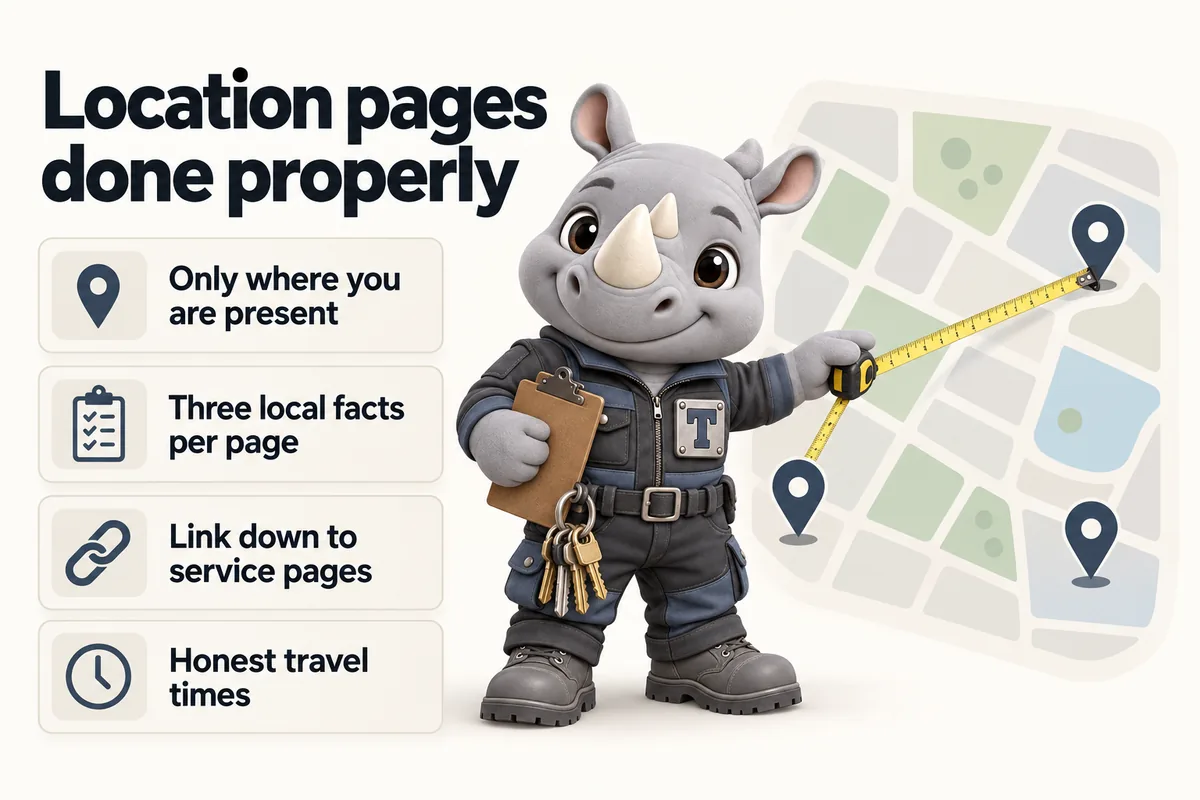
A multi-site facilities contractor should build a location page for every market where it has something genuinely specific to say, and no page at all for markets where it does not. The specific thing can be a depot, a directly employed team, a named contract, a stated response time, or an operational fact about that market that does not apply elsewhere. If none of those exist for a place, the page will be a doorway page, it will not rank, and it will make the rest of the site look worse.
That is the whole argument, and it runs directly against how location pages are usually built. The common approach is to take one page of service copy, generate fifty variants with the place name swapped, and publish them. It used to work. It stopped working, and Google’s spam policies now name doorway pages explicitly as pages created to rank for particular searches that funnel users to the same destination without distinct value.
What Buyers Are Actually Asking
The search behind a coverage query is almost never “who does facilities management in this town”. It is “does the supplier I am considering cover me”, or “who can get to my site fast enough”.
That distinction changes the page. A buyer running the first query already has a shortlist and is checking a box. They need a fast, unambiguous yes or no, and they need it without reading. A buyer running the second query is building a list and is looking for evidence of proximity that they can believe: a depot, a named team, a response time, work at a recognisable local site type.
Neither of those buyers wants a page of general service copy with their town name in it. The first wants a coverage statement. The second wants proof of presence. Both are answerable in a page that is mostly specific facts.
The Three-Fact Test
Before building a location page, write down three things that are true of that market and not true of your other markets. If you cannot, do not build the page.
The facts that qualify are operational, not descriptive. A depot or office address. The number of directly employed operatives working there, or the fact that delivery is through a named supply chain partner. A stated response time from the nearest staffed point. Contract types you actually hold there, even anonymised by sector. Site types common in that market that you have experience with, such as a cluster of logistics warehouses, a university estate, or a hospital trust.
What does not qualify: the population of the town, its history, a description of its business district, or a sentence about how the town has a thriving commercial property market. That material is filler, it is usually paraphrased from somewhere else, and it is the clearest signal that the page was generated rather than written.
A useful discipline is to write the three facts first, as bullet points, before writing any prose at all. If the bullets are thin, the page will be thin, and you will have learned that in two minutes instead of after publishing forty pages.
What the Page Should Contain
A location page that works tends to run in the same five parts.
The Coverage Statement
One sentence at the top that answers the checking buyer immediately: what you cover from this base, and what the boundary is. Name the towns, boroughs or postcodes, not a radius. A radius on a map is not an answer to “do you cover us”; a list of place names is.
The Presence Evidence
The three facts, stated plainly. This is the section that makes the page not a doorway page, and it is the section most often missing. A depot address, a team size, a response time commitment, a note on whether cover is directly employed or through partners.
If your presence in a market is genuinely a mobile team from a neighbouring region, say that. It is a weaker claim than a depot, but it is a true one, and it still answers the buyer’s question. A contractor who wins work by implying local presence and then arrives two hours after a leak has not won anything worth having.
What You Deliver Here
A short list of the service lines you actually run in this market, each linking to its own service page for the scope, frequency and exclusions. Resist the urge to restate that detail here. The service page is where scope lives, and duplicating it across regions is exactly the pattern that produces near-identical pages.
Where a service line is genuinely different in this market, say how. Winter gritting matters differently in different climates. A market dominated by listed buildings has different fabric maintenance constraints. Those differences are worth a sentence each and they are the kind of detail no template can generate.
Local Contact and Escalation
Who a buyer in this market reaches, and how. If there is a regional manager, name them. If everything routes through a central desk, say that and state the response commitment, which is more honest than inventing a local number that diverts anyway.
A Way to Start
A route to an enquiry that is specific to this market, so that the enquiry arrives already carrying the location. A generic contact link at the bottom of a regional page throws away the one piece of information the page had established.
The Coverage Table Most Sites Are Missing
Before any regional page exists, there is a cheaper asset that solves most of the coverage problem on its own: a single coverage table on one page.
Rows are markets. Columns are the things a buyer wants to know: what you deliver there, whether delivery is directly employed or through partners, the response time, and the nearest staffed base. Twenty rows fit comfortably on one page and answer the checking buyer faster than twenty separate pages do, because they can see the whole footprint at once and compare it against a portfolio that spans several of those markets.
For multi-site buyers this table is often the single most useful thing on the site, and it is frequently the thing that decides whether a portfolio enquiry happens at all. A facilities manager with eleven sites is not going to open eleven regional pages to find out which of their sites you can cover. They will open one page, look for a table, and if there is not one, assume the answer is complicated.
Build the table first. Then build regional pages only for the markets whose rows have enough behind them to justify a page of their own. In a surprising number of cases the table turns out to be sufficient, and the regional pages that do get built afterwards are better for having had to earn their place against it.
The Structured Data Question
Location pages invite LocalBusiness structured data, and this is where a lot of facilities sites quietly break their own credibility.
Google’s documentation on local business structured data is aimed at businesses with a physical location or a defined service area, and it expects the marked-up details to match what is actually on the page and true of the business. Marking up a regional page as a LocalBusiness with an address you do not occupy is not a technical shortcut; it is a misrepresentation that a competitor can report and that a buyer can notice.
The honest positions are straightforward. Where you have a real staffed location, mark it up as such, with the address that appears on the page. Where you cover a region from elsewhere, describe the service area rather than inventing a location. And where the page is genuinely a coverage page rather than a branch page, Service markup with an areaServed is a better fit than LocalBusiness, because it says what is true.
The same rule applies to Google Business Profiles, which are a separate system with their own guidelines. Those guidelines require a location where you make in-person contact with customers, or a service area defined without a fake address. Virtual offices and mail drops used to be a common workaround in this industry. They are a liability now.
How Many Pages Is Too Many
There is no universal number, but there is a reliable test: the moment you find yourself generating pages rather than writing them, you have passed the limit.
A regional contractor with four depots has four strong pages and possibly a handful of secondary ones for adjacent markets served from those depots. A national provider with twenty staffed locations has twenty. A single-site contractor covering one county has one page, and it should be a good one, not eight thin ones for the towns inside that county.
The instinct to cover every town comes from an older model of local search where matching the query string mattered more than matching the intent. What actually happens now on a site with forty thin regional pages is that none of them rank, the crawl budget is spent on pages nobody reads, and the site as a whole reads to both a search engine and a buyer as padded. Google’s guidance on people-first content is explicit that content made primarily to attract search visits rather than to help people is the thing it is trying not to reward.
Writing Ten Pages Without Writing One Page Ten Times
The practical difficulty is not deciding to write specific pages. It is sustaining specificity across ten of them when the tenth is due and the material has run out.
Two habits make it possible. The first is to gather the raw material before writing anything. Ask operations for one spreadsheet: market, base, headcount, delivery model, response time, current contract types by sector, and anything unusual about the estate there. That single request produces enough distinct fact for every page you are entitled to build, and it produces it in a form where the thin markets are immediately visible as empty rows.
The second is to write the pages in descending order of material. Start with the market you know best. Write it completely and well, and let it establish the shape. Then work down. By the time you reach a market with only two real facts, you will notice the drop in substance while you are writing rather than after publishing, and the right decision, which is usually to fold that market into a neighbouring page rather than give it its own, becomes obvious.
The failure mode to watch for is the padding sentence. It appears when the facts have run out and the page feels short: a line about the local economy, a paragraph about the importance of well-maintained buildings, a restatement of a service already described elsewhere. Every one of those is a signal that the page should have been shorter or should not exist. A three-paragraph location page that is entirely true is a better asset than a twelve-paragraph one that is two thirds filler.
What Regional Pages Do for the Rest of the Site
Well-built location pages earn their keep twice, and the second way is easy to miss.
The obvious return is the coverage query: a buyer checking whether you reach them, and finding a page that says yes with evidence. The less obvious one is what those pages do for the service pages above them. A janitorial service page that links down to six regional pages, each of which says what janitorial delivery looks like in that market, is demonstrably a page about a real operation rather than a claim. The internal link structure carries that, and so does the reading experience.
That relationship also decides the direction of linking. Regional pages link up to service pages for scope. Service pages link down to regional pages for coverage. Neither duplicates the other, and a visitor arriving from either direction can complete their question in one more click. A site where both page types try to be complete on their own ends up with two sets of the same copy and no clear answer anywhere.
A Short Sequence to Follow
Ask operations for the market spreadsheet. Delete every row that cannot produce three specific facts. Write the strongest remaining market completely. Publish it, link it from the relevant service pages, and leave it for a few weeks. Then write the next one.
Resist building the whole set at once. A partial set of honest pages is a working asset from the first page. A complete set of generated ones is a liability from the day it ships, and it is considerably harder to remove than it was to create.
Maintaining Them
Location pages go stale faster than any other page type on a facilities site, because they encode operational reality and operational reality moves.
Depots close. Teams change size. A response time commitment made when a market had two vans is not the same commitment when it has five. A contract that made a market credible ends. Each of those changes makes a specific sentence on a specific page untrue, and the untrue sentence is the one a buyer will find.
Put the review on the same schedule as whatever internal process already tracks depots and headcount, rather than treating it as a marketing task. In practice the simplest workable rhythm is a quarterly pass over the presence-evidence section of every location page, checking only the facts, not the prose. That takes minutes per page and it is the difference between a page that builds credibility and one that spends it.
When Not to Build Them At All
Some facilities businesses should not have location pages, and it is worth saying so.
If you deliver nationally through a central account structure and your buyers are national account managers rather than site-level facilities managers, regional pages solve a problem you do not have. Your buyer is not searching by town; they are evaluating whether you can run a portfolio. What that buyer needs is a multi-site coverage page that shows the structure of your delivery, not a directory of places.
Similarly, if your work arrives entirely through frameworks and managing agents, the marginal value of a town page is close to zero and the effort is better spent on the capability material those buyers actually read.
The question worth asking before building any of these pages is simply whether a real person will ever arrive at it with a real question. If the honest answer is no, the page is for a search engine, and search engines stopped rewarding pages built for search engines some time ago.
Sources
Frequently asked questions
What makes a location page a doorway page?
A location page becomes a doorway page when it exists only to capture a place name and carries no information that is specific to that place. Google describes doorway pages as pages created to rank for particular searches that all funnel users to the same destination without offering distinct value.
How many location pages should a facilities contractor have?
One for every market where you have something genuinely specific to say, which usually means somewhere you staff, hold contracts, or can reach within a stated response time. That is often far fewer pages than the list of places you would accept work in.
Do I need a physical address for a location page?
Not for a website page, but you do need one for a Google Business Profile, which requires a location where you make in-person contact with customers or a defined service area. The website page and the profile are different things with different rules, and conflating them causes most of the trouble in this area.
Should a location page repeat all my services?
No. It should say what you deliver in that market specifically and link to the service pages for the detail. Repeating full service copy on every regional page is exactly what produces near-duplicate pages that add nothing.
What if we cover a region from a depot two hours away?
Say so, and state the response time that follows from it. A buyer who reads an honest travel time and accepts it is a better contract than one who discovers it during the first out of hours callout.
Want a site like the one described here? Book a demo with FacilityWebStudio.