Closes DEF-01
A page per service line
Janitorial, hard services, grounds and every other line you run gets its own page, written in the vocabulary that service is actually searched for.
Built inFacilityWebStudio directory84 destinations
Nothing on the board matches . Try a plainer word, or ask a person.
Theme
Colour
Saved on this device. Press Esc to close.
File FWS-01Issue 2026For facilities management companies
01Documented service levels, not adjectives
02Live in 7 days on Baseline Ledger
03Managed hosting and weekly updates, included
A fully managed, custom-coded website for facilities management companies: a documented service level ledger, live in 7 days, weekly researched articles and managed hosting, all on one monthly plan.
Service level ledger
Rev 04| Service | Frequency | Coverage |
|---|---|---|
| Nightly cleaning | 5x / week | All floors |
| HVAC inspection | Monthly | Rooftop units |
| Emergency callout | Under 4 hrs | 24 / 7 |
| Grounds maintenance | Fortnightly | North site |

Service register
Term 01
7 days
To launch on Baseline Ledger
Term 02
90+
Guaranteed PageSpeed score
Term 03
5
Revisions included every month
Term 04
$0
Build fee charged before launch
Client notes
If you only look at the design you miss the best bit, which is the inquiry form. It collects property use, floor area and service schedule up front, so the back-and-forth we used to do by reply has largely gone. Most mornings I can prepare for the callback from the first message alone.
Inquiry form and response workflow for facility walkthroughs
Most of our visitors are on phones, so that is where I reviewed the new facility walkthroughs pages. Everything a visitor needs is up top, and the inquiry button stands out properly. Staff can now text a single link mid-call instead of narrating the menu.
Mobile navigation and page layout for facility walkthroughs
Case files
Most facilities management sites lose a shortlist review for structural reasons, not because the business behind them is weak.
DEF-01
One page tries to describe janitorial, hard services and grounds maintenance at once, so none of them reads as a real capability.
DEF-02
There is no documented service level table, so a procurement reviewer cannot check your commitments against their own specification.
DEF-03
Coverage areas and locations are claimed in one paragraph instead of built as real pages, so local searches find a competitor instead.
DEF-04
A quote or walkthrough request lands in a shared inbox nobody checks daily, while the buyer has already called someone else.
DEF-05
The site was built once, years ago, and has not been updated since a service line changed or a new certification was earned.
Doing nothing looks free. For a facilities company, an outdated site costs in contracts, in speed of reply, in search traffic and in ad budget, every month it stays as it is.
COST-01
Every shortlist review you do not survive is a recurring contract that runs for years with someone else, not a single lost job.
COST-02
Every enquiry that waits until Monday in a shared inbox is a buyer who has already booked a walkthrough with the contractor who replied first.
COST-03
Every month without service-area pages is another month a local competitor collects the searches for the cities you already serve.
COST-04
Every paid click that lands on a slow, generic page is ad budget spent on someone who left before reading your offer.
Every fault above is answered with a specific, built feature, not a promise to try harder.
Closes DEF-01
Janitorial, hard services, grounds and every other line you run gets its own page, written in the vocabulary that service is actually searched for.
Built inCloses DEF-02
Response times, frequencies and coverage in a real table, so a reviewer can check your site the way they check a contract exhibit.
Built inCloses DEF-03
A page per region you serve, written for that market, built to be added to as you expand rather than rebuilt each time.
Built inCloses DEF-04
Every quote request and walkthrough booking lands in your CRM by API, Zapier or Make, the moment it is submitted.
Built inCloses DEF-05
Small factual changes go live every week, so the site reflects the business you run this quarter, not the one you ran at launch.
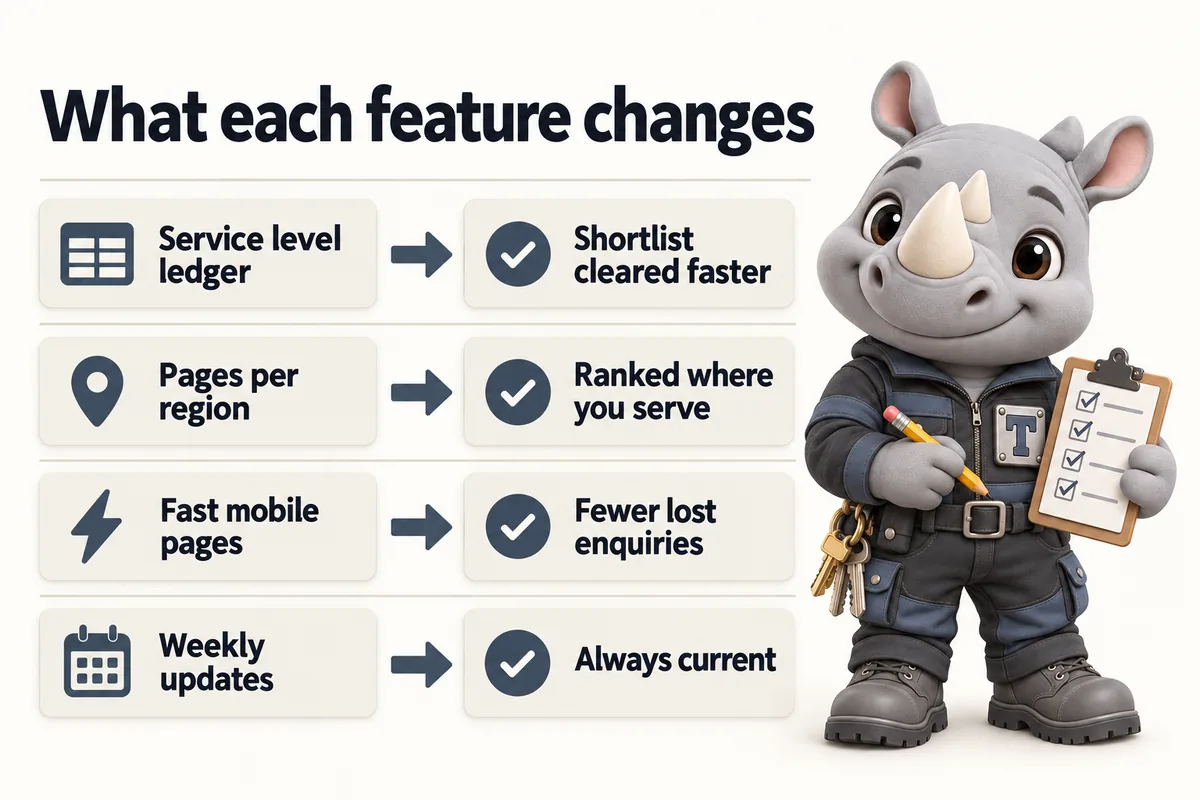
Built inA documented service level ledger answers the questions a procurement reviewer asks first, before they have to email you for a spec sheet.
Real pages per region and per service target the specific searches a facilities manager runs, rather than one page competing for everything at once.
A page that opens instantly on a phone keeps the reviewer who was one tab away from moving to the next vendor.
Weekly updates and included revisions mean a new certification or service line shows up on the site the same month it happens.
A facilities management buyer expects response times, frequencies and coverage documented in a table, the same way a contract exhibit reads, not described in a paragraph of adjectives.
Exhibit A
| Service or term | Commitment | Coverage |
|---|---|---|
| Site revisions | 5 / month | Any size, no cap on total requests |
| Revision turnaround | 2 to 5 working days | From request received |
| Page speed | 90+ PageSpeed | Mobile and desktop, every page |
| Researched articles | 2 to 3 / week | By plan, 2,500 to 3,200 words each |
| Hosting uptime response | Monitored continuouslyIllustrative | Cloudflare edge network |
| Domain registration | Included, in your name | For the life of the plan |
Rows marked illustrative describe how a term is typically documented rather than a numeric guarantee. Every other figure is a real term of the plan, not an estimate.
Every plan carries the core list below; the second and third plans add the AI Engine and the Content Engine. Not included on any plan: running your facilities services, paid ad spend, printed material, or legal and compliance advice.
Home, services, locations, about, contact and enquiry pages, built as one system.
Documented commitments on your key service pages, kept current as revisions.
Registered in your name for as long as your plan is active, or we point your own.
Cloudflare hosting with SSL, CDN and DDoS protection, nothing itemised.
Every form routes into any CRM by API, Zapier or Make.
We handle updates and technical maintenance for the life of the plan.
Service-area pages, answer-first copy, structured data and an llms.txt file, on every plan.
Privacy policy, terms, a cookie banner that really blocks scripts and an accessibility statement.
Every URL on your current site mapped and redirected, so rankings carry over.
2,500 to 3,200 words each, written for facilities buyers, rising to 3 on the top plan.
5 revisions a month of any size, each done within 2 to 5 working days.
AI receptionist with call summaries, site chat, and SMS, Messenger and Instagram replies.
Supervisors are walking buildings, crews work nights, and the office closes at five. On Operating Ledger and Enterprise Ledger, the AI Engine answers first, takes the details, and hands anything that needs judgment to a person.
Answers inbound calls when your team is on site, busy or off shift, describes your services, takes the enquiry details and books the next step.
The problem it removes: Calls come in while supervisors are walking a building or after the office closes. Voicemail loses the ones who needed an answer tonight, including the urgent callouts.
Your part: Review and approve the script before launch. Read the summaries afterwards.
Adds a chat widget to every page that answers questions about your services and coverage and collects contact details for follow-up.
The problem it removes: A buyer comparing vendors at 9 p.m. has one question about coverage. With no one to ask, they move on to a site that answers.
Your part: Approve what it knows about your services. We keep it updated as revisions.
Replies to text messages, Facebook Messenger and Instagram direct messages in minutes, answers service questions and books a walkthrough or call-back.
The problem it removes: Messages sit unread for a day because nobody owns the inbox, and a slow reply to a property manager looks exactly like a slow response time on site.
Your part: Approve the replies before launch. We file the carrier registration for texting.
Operating Ledger is $297 a month plus AI usage. Text messaging needs carrier registration (A2P 10DLC), which we file for you, with carrier fees passed through at cost. How the AI Engine works.
A fast page keeps the buyer who was about to leave, and it supports the part of Google Ads Quality Score that looks at your landing page.
Guaranteed on mobile and desktop, on every page we ship.
Paid clicks
Google Ads gives every keyword a Quality Score, and landing page experience is one of its three parts: how relevant and useful the page is to the person who clicked. A fast service page that matches the search, works properly on a phone and answers the buyer's first question gives that part its best chance, and a better Quality Score can lower your cost per click. Just as important, more of the paid clicks you already buy stay long enough to read the page and send an enquiry, instead of leaving while a heavy page loads. We never promise a specific cost per click or percentage; we make sure the landing page is not what holds your campaigns back.

Buyers now search three ways: a search engine, an answer box, and an AI assistant. Every plan is built for all three, with structured data underneath.
SEO
Clean URLs, sitemaps, redirects and fast pages, then one clear topic per page and a distinct page for each city or region you serve, so a search like "commercial cleaning in Houston" has a page of yours to land on. That is organic traffic you do not pay for per click.
AEO
Every section opens with a direct answer, FAQ blocks answer what buyers ask, and the service level table gives answer engines a clean block to lift into a featured snippet or a spoken answer.
GEO
An llms.txt file, consistent business facts on every page and plainly stated commitments make your company easier for AI assistants to understand and cite. No one can guarantee an AI answer; we make it more likely.
Schema
Organization or LocalBusiness, Service, FAQPage and BreadcrumbList, plus Review once you have real reviews, so search engines understand exactly what each page is about.
The build has four stations. After launch the loop keeps running: revisions, weekly updates and articles cycle through the same stations for the life of the plan.
Stage 01
That starts the plan and the build clock. The build fee is not charged yet.
Stage 02
We walk through your service lines, coverage areas and current service level commitments, and agree the launch date.
Stage 03
Live in 7, 10 or 15 days depending on plan.
Stage 04
Only after your site is live and you have confirmed you are satisfied with it.
The site is live. Every service line has its own page, the ledger shows your real commitments, and enquiries land in your CRM instead of a shared inbox.
Around 24 researched articles are published on the questions your buyers search. A new certification and a new county went live the week you won them.
A property manager sends a walkthrough request at 9 p.m. It is answered, logged and waiting in your pipeline by morning, and your proposal matches what your website already documents.

We do not publish invented results. Here is the arithmetic a facilities owner can do in two minutes with figures only you have.
Step 1
Take the monthly value of one typical recurring account: one office building, one school, one property on a maintenance schedule.
Step 2
Multiply it by the months that account usually stays with you. Facilities contracts renew, so this is often measured in years.
Step 3
Compare that with a year of the plan: $1,644 on Baseline Ledger, plus the $797 build fee charged after launch. If the site helps you win or keep a single account, it has usually paid for itself.
The same arithmetic applies to ads: if a faster, more relevant landing page keeps more of the paid clicks you already buy, each of those enquiries costs less.
Every plan includes the full site, the service level ledger, hosting and weekly updates. Tiers 2 and 3 add the AI Engine and Content Engine.
Baseline Ledger
$137/ month
The website, fully managed
Operating Ledger
$297/ month + usage
Everything, plus the AI Engine
Enterprise Ledger
$747/ month
Everything, plus the Content Engine
Plus a $797 one-time build fee, invoiced only after your site is live and approved.
| Feature | Baseline Ledger$137/ month | Operating Ledger$297/ month + usage | Enterprise Ledger$747/ month |
|---|---|---|---|
| The website itself | |||
| Pages that open instantly | |||
| Service level ledger table | |||
| Location and service-area pages | |||
| Enquiries into your CRM | |||
| Compliance pages and accessible build | |||
| Search, answers and AI citations | |||
| SEO, AEO, GEO and schema | |||
| The AI Engine | |||
| AI receptionist with call summaries | |||
| AI chat on your website | |||
| AI replies on SMS, Messenger and Instagram | |||
| The Content Engine | |||
| Researched articles every week | |||
| Social posts and reels | |||
| Managed Google Business Profile | |||
| Management and ownership | |||
| Revisions and weekly detail updates | |||
| Managed hosting and security | |||
| Your domain, in your name | |||
| Move from your current site, rankings intact | |||
| Client portal for every request | |||
Every plan carries a $797 one-time build fee, invoiced only after your site is live and approved. The AI Engine plan adds AI usage on top of its monthly fee; text-message carrier fees are passed through at cost.
Next to the rate card
The starting point was our own sent mail, not a template, and it shows. Nothing went live until the person responsible for that subject had signed off the answer. I now share a link instead of digging through the outbox.
FAQ research and editorial review for facility walkthroughs
The 'did you receive it?' calls about facility walkthroughs were a daily occurrence here. The new confirmation states what happens next and how to amend anything that needs changing. It sounds minor until you add up the reassurance calls it has replaced.
Submission acknowledgment and follow-up for facility walkthroughs
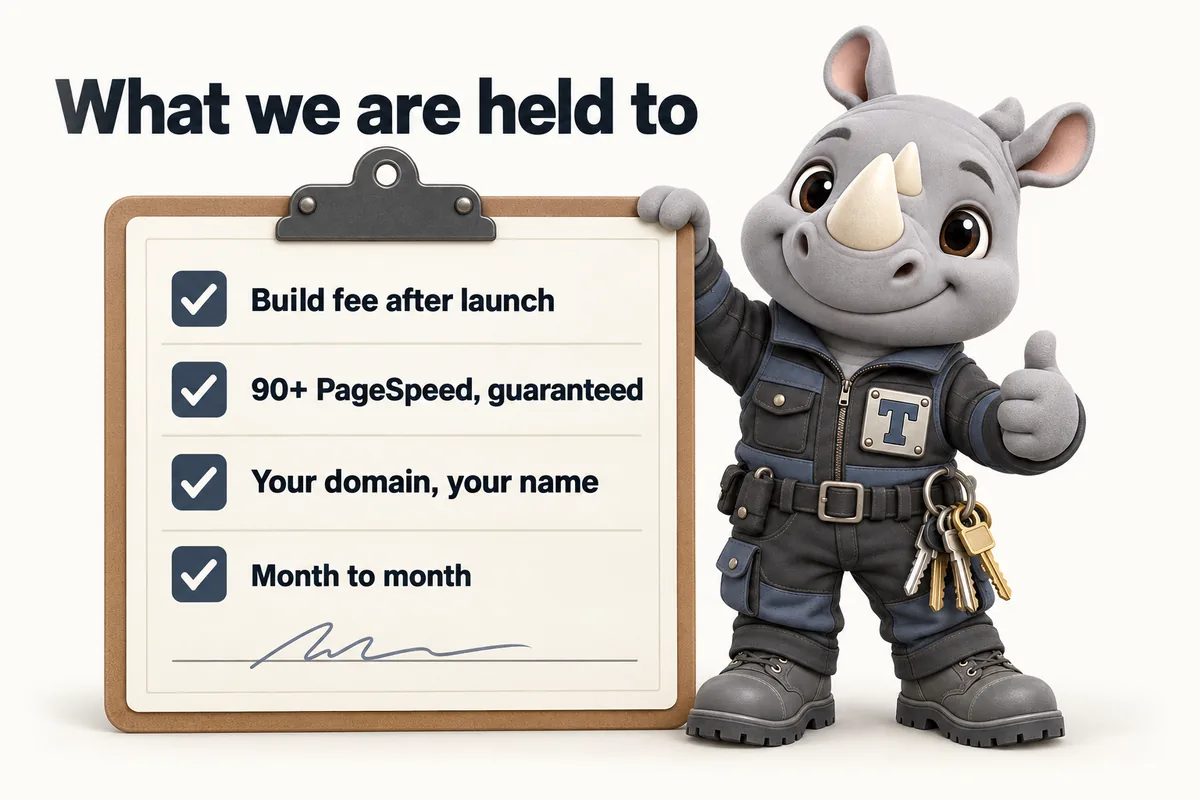
The terms that move the risk of a new website from you to us.
The $797 build fee is invoiced only after your site is live and you have approved it. You see the finished work before you pay for the build.
On mobile and desktop, for every page we build and host. A page that falls below it because of our work is fixed at no charge.
Registered to you from day one and transferred free if you ever leave. No vendor holds your address hostage.
No long contract. Cancel with notice before your next invoice date, as set out on the pricing page and in the terms.
We have no industry licences to show, because we are not a facilities contractor; we are the team that builds and runs your website. What we can show is our own service level ledger, printed in the footer of every page.
Every site ships with the policy pages and consent mechanics a US business site is expected to carry. They help you meet those expectations; they are not legal advice.
Written for a US business site, with US state privacy laws such as the California Consumer Privacy Act in mind.
A banner that genuinely holds analytics and marketing scripts back until a visitor agrees.
Pages built toward ADA expectations and the WCAG 2.2 AA guidelines, and a statement saying how to report a problem.
On any form that collects a mobile number, written with TCPA consent wording and carrier A2P 10DLC registration in mind.
For facilities companies we also keep security-sensitive detail off public pages: no client access procedures, key-holding arrangements or building layouts, unless your contract allows it. Read how we handle it.
We work remotely with facilities companies wherever they operate, from janitorial contractors in Texas, Florida and California to mechanical and HVAC firms in Georgia, Illinois and Ohio. What changes from market to market is the vocabulary, the seasons and the cities a buyer searches, so every client gets service-area pages for the exact places they cover, not a national page that names none of them.

4 operators, 4 different service mixes. Swipe a badge to read it, or let the wall read itself as you scroll. On a phone the wall swipes sideways, one badge at a time.
Hard services maintenancePreparation guide and inquiry support for facility walkthroughs
The facility walkthroughs preparation page does one job and does it well. Visitors arrive knowing what the first discussion covers and what they should think about beforehand. It has replaced the hurried afternoon rewrite of the same instructions.
Jordan SandersonService delivery coordinator, public building maintenance contractor, Billings, Montana
Soft services providersService scope and expectations for facility walkthroughs
The time we spent on the facility walkthroughs wording was time well spent. The boundaries are drawn clearly: what the site settles, and what our people still decide. Correcting the site's accidental promises is no longer part of our calls.
Maurice CrawleyScheduling supervisor, healthcare premises support services, Tulsa, Oklahoma
Integrated facilities managementInquiry assignment and staff handover for facility walkthroughs
We used to forward facility walkthroughs emails around and hope somebody had replied. Requests are assigned automatically, with a backup for when the owner is away. Holiday cover stopped being an archaeological exercise.
Derek CresswellHelpdesk supervisor, office campus services contractor, Harrisburg, Pennsylvania
Commercial property managementStructured reference pages for facility walkthroughs
We knew the facility walkthroughs document was a problem; we had just never prioritized fixing it. Each section has its own link, so answering a question no longer means attaching the whole file. A printable copy still exists for those who ask.
Habiba LatifFacilities administrator, shopping precinct maintenance team, Lexington, Kentucky
Reviews from real clients, published with their permission. Avatars are initials, not photographs, and no star ratings or review counts are shown.
Each of those can be the right choice. Each comparison below says honestly when, and when a managed site suits a facilities company better.
Next step
Book a 30-minute demo and we walk through a site built for a facilities company like yours, including a sample service level ledger. Plans from $137 a month, build fee after launch.
The questions facilities owners ask most about the offer, visibility, the AI Engine, compliance and billing. The full list, grouped by topic, is on the FAQ page.
A fully managed, custom-coded website for a facilities management company, built around a documented service level ledger table rather than generic service copy. It includes named pages for every service you run, weekly updates, 2 to 3 researched articles a week depending on plan, enquiries routed into your CRM, and hosting, all on one monthly fee plus a one-time build fee invoiced only after launch.
7 days on Baseline Ledger, 10 on Operating Ledger while the AI Engine is configured and trained on your services, and 15 on Enterprise Ledger with the Content Engine set up alongside it. The clock starts at the onboarding call, not at purchase, so the sooner the onboarding form is in, the sooner you are live.
Yes, and it is worth being precise about it. We build and manage your public-facing website: the pages a prospective client or their procurement team reads before they call you. We are not a CAFM, work order or CMMS software vendor, and the site does not replace whatever system you use to manage maintenance schedules or dispatch internally.
You fill in the onboarding form and submit it. It asks for your service lines, coverage areas, current service level commitments, your brand, your domain and where enquiries should land, and it takes about 15 minutes. If something is missing, submit anyway: you can send the rest by email or raise it as a ticket in your client portal, and it will not hold up the build. We then run one onboarding call to fill any gaps and agree the launch date.
It can help. Google Ads Quality Score has three parts, and one of them is landing page experience: how relevant and useful the page is to the person who clicked. A fast, specific service page gives that part its best chance, and a better Quality Score can lower cost per click. More of the clicks you already pay for also stay long enough to enquire. We guarantee 90+ PageSpeed; we do not promise a specific cost per click or ranking.
SEO is being found and ranked by search engines. AEO, answer engine optimization, is being the answer pulled into a featured snippet, a voice answer or an AI summary. GEO, generative engine optimization, is being cited by AI assistants such as ChatGPT, Claude, Perplexity and Google AI Overviews. Every plan covers all three: technical and on-page SEO, answer-first copy with FAQ blocks, and an llms.txt file with consistent, citable business facts.
Yes. We build a distinct page for each city, metro or region you actually serve, with the services available there, so local searches like "janitorial services in Dallas" have a page to land on. New areas are added later as revisions. We never publish thin pages with only the city name swapped, because search engines filter them.
On Operating Ledger and Enterprise Ledger, it adds an AI receptionist, site chat, and SMS, Messenger and Instagram response, all configured to describe your services, take enquiry details, and route the request rather than give advice about a caller's specific facility. Anything requiring judgment is handed to a person at your business.
A privacy policy, terms of use, a cookie policy with a consent banner that genuinely holds analytics and marketing scripts back until a visitor agrees, an accessibility statement, and consent wording on any form that collects a mobile number for text messages, written with TCPA consent wording and carrier A2P 10DLC registration in mind. They help you meet common expectations for a US business site; they are not legal advice, and your own counsel has the final word.
Yes. The service is delivered remotely, so location does not limit who we build for. We write for facilities companies wherever they operate, from Texas, Florida, California and Georgia to Illinois, Ohio, North Carolina and Arizona, and build service-area pages for the exact cities and regions each client covers.
You pay the monthly fee for the tier you choose up front: $137, $297 plus AI usage, or $747 a month. The $797 one-time build fee is invoiced only after your site is live and you are satisfied with it. Domain and hosting are inside the monthly figure.
Email us and say you want to cancel. Your message must reach us at least 2 business days before your next invoice date, during business hours, which are 9:00 to 17:00 Central Time, Monday to Friday. A message sent outside those hours counts from the start of the next business day, so a weekend email does not give 2 business days of notice for an invoice due Monday or Tuesday. With valid notice, no further invoice is raised and your site runs to the end of the month you have paid for. With late notice, the next invoice is charged as normal and the cancellation takes effect at the end of that month.
Close of file
A live walk-through, on your screen, from $137 a month plus a $797 build fee invoiced only after launch.
FacilityWebStudio uses the cookies below. Necessary cookies keep the site working and cannot be turned off.
Saved on this device only. Press Esc to close.