Filed Contracts and bidsLength 11 minWords 2,636
What Belongs on a Facilities Contractor Capability Statement Page
A capability statement page is one URL a bid evaluator can open, read and score. What it must carry, in the order a prequalification questionnaire asks for it.
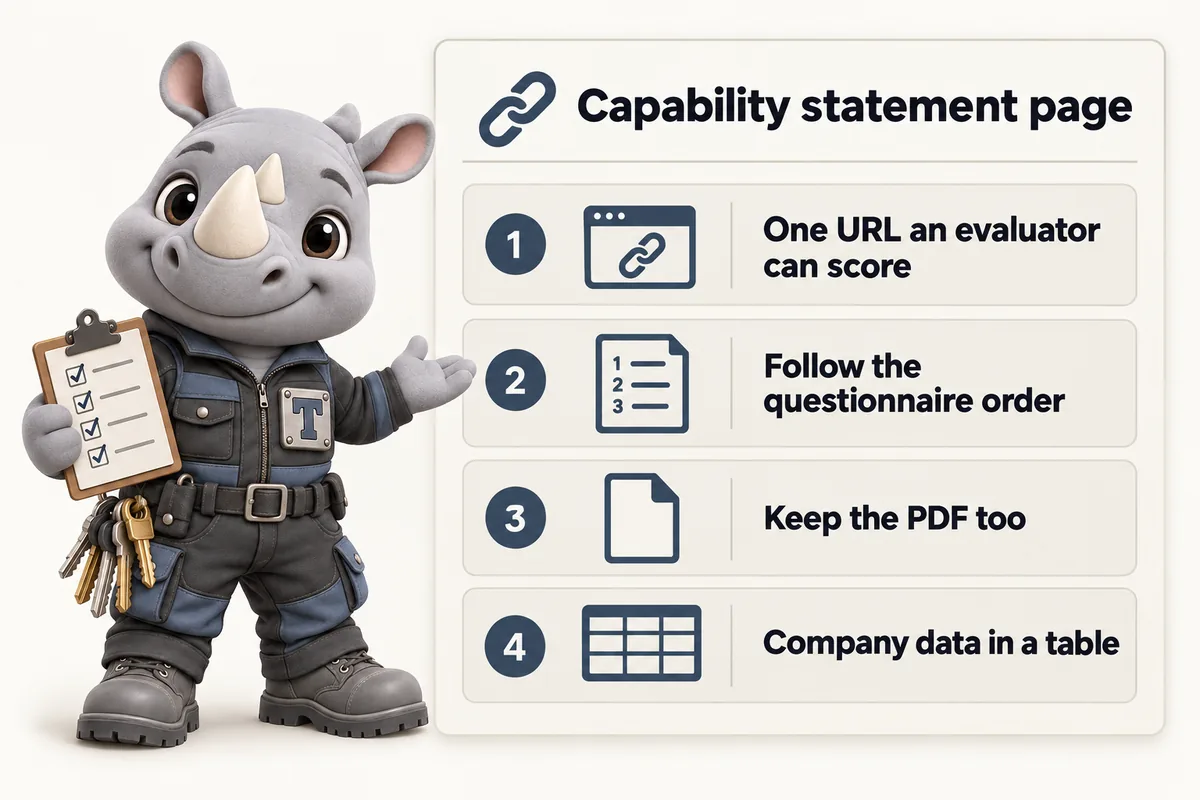
A facilities contractor capability statement page should carry five things, in this order: core competencies, differentiators, past performance, company data, and the bid contact. That order is not arbitrary. It is the order that most prequalification questionnaires ask in, and matching it means an evaluator with a scoring sheet can work straight down your page instead of hunting.
Most facilities companies already have a capability statement. It is a PDF, it is attached to emails, and it is somewhere on a shared drive in three versions with unclear dates. What almost none of them have is the same content at a stable URL, and that gap costs more than it looks like it should. A bid document cannot cite a PDF on your hard drive. An evaluator running a quick credibility check at nine at night cannot email you for a file. A procurement officer building a supplier list wants to paste a link into a spreadsheet, not manage an attachment.
Why the URL Matters More Than the Format
The argument for a page over a document comes down to what happens in the minutes before a decision.
A supplier shortlist in facilities management is usually assembled by one person under time pressure, working from a mix of recommendations, a search, and whatever the existing framework or portal offers. That person is checking whether each candidate is real and whether they are plausibly capable at the required scale. They are not reading carefully at this stage. They are scanning for disqualifiers.
A stable URL survives that process in ways a document cannot. It can be pasted into an email to a colleague. It can be cited in a bid as evidence rather than duplicated into an appendix. It can be found by someone who heard your name at a site meeting and typed it into a search box. It is always the current version, which the PDF in someone’s inbox from eighteen months ago is not.
The United States General Services Administration’s own guidance on capability statements describes them as a concise summary a buyer can use to assess fit, and emphasises keeping them current and specific. The page format makes “current” a property of the thing rather than a discipline you have to maintain across every copy that has ever left your building.
Section One: Core Competencies
Open with what you actually deliver, in operational language, with no marketing framing at all.
This section should be scannable in ten seconds and specific enough to be checkable. For an integrated provider that means naming the hard and soft service lines separately rather than hiding both inside the word integrated. For a specialist it means naming the specialism precisely: not “mechanical services” but planned and reactive maintenance of air handling, chilled water and boiler plant, with the qualifications your engineers hold.
Two failure modes are worth naming. The first is the list that is so broad it reads as a company that does everything and specialises in nothing. The second is the list written in the buyer’s marketing language rather than their operational language: “workplace experience solutions” where the questionnaire says “cleaning services”. Match the questionnaire. The evaluator is going to have to map your words onto their categories, and every mapping step is a chance to lose a point.
If your service lines each have their own page, link to them from here. The capability page is a summary and a router; it does not need to contain the detail that lives on a service page, and it reads better when it does not try to.
Section Two: Differentiators
State what you do that a comparable supplier at your size does not, and make every claim one that could be falsified.
This is the section that goes wrong most often, because it is the section that invites adjectives. “Customer focused”, “reliable” and “quality driven” are not differentiators; they are claims every one of your competitors is also making on their own page, which means they carry no information and cost you the space they occupy.
A real differentiator is structural. Directly employed operatives rather than a subcontracted supply chain, if that is true. An in-house out of hours desk rather than an answering service. A named account manager with a stated caseload. Coverage of a region a larger provider services from three hours away. Accreditation to a standard that is uncommon at your size. Experience in a building type with unusual requirements, such as a live healthcare environment or a data centre.
The test is simple: if a competitor could copy the sentence onto their own site without lying, it is not a differentiator. Delete it.
Section Three: Past Performance
Show evidence of delivery at the scale the buyer is considering you for, and anonymise it where you must rather than omitting it.
Many facilities contracts contain confidentiality terms that prevent naming the client. This is a real constraint, and the common response to it, leaving the section out, is the wrong one. Anonymised evidence still carries the information an evaluator needs, which is scale, sector and duration rather than identity. A line that reads “a 240,000 square foot multi-tenant office in the region, daily janitorial across eleven floors, in contract since 2021” tells an evaluator nearly everything they wanted from a named reference.
Where you can name clients, name them, and keep the entries short: client, sector, scope, scale, duration. Where you can name a sector but not a client, say so plainly rather than leaving an implication hanging. And where you genuinely have no comparable past performance at this scale, do not manufacture it. An evaluator who catches an inflated reference has learned something about you that no other section of the page can undo.
Section Four: Company Data
Put the administrative facts in a real table, because this is the section an evaluator copies from.
What belongs here depends on where you operate, but the shape is consistent: legal entity name, trading name if different, registered address, registration numbers, tax identifiers, industry classification codes, business size classification where relevant, accreditations and their certificate numbers, insurance types and limits with the renewal month, and any framework or approved-supplier listings you hold.
Two details make this section materially more useful. First, put it in a table rather than prose, because it is reference material and it will be read as reference material. Second, include the numbers themselves rather than just the names of the schemes. An evaluator verifying an accreditation needs the certificate number; sending them to a registry with only your company name is a task you have handed back to them.
This section also happens to be where Organization structured data earns its keep, because the facts on the page and the facts in the markup can be made to agree exactly. That matters for the growing number of research tools that read a site on a buyer’s behalf rather than making them read it themselves.
Section Five: The Bid Contact
End with the person who handles bids, by name, with a direct route to them.
Not a generic enquiry form. Not info@. A named person, a direct line or a monitored inbox, and a statement of what they will do with a request and how quickly. If you have a formal process for receiving invitations to tender, state it: what format you accept, what notice you need, and what you will need from the buyer to respond.
This is a small section that does disproportionate work, because it changes the reader’s mental model from “a company” to “a person who will answer”. A buyer under deadline pressure will contact the supplier whose page makes that easiest, and the difference between a name and a form is larger than it looks.
How an Evaluator Actually Reads It
Watching a procurement reviewer use a capability page changes what you put on it, because the reading pattern is not the one the page was probably written for.
They arrive already holding a question, usually one of three. Is this supplier the right size for this contract. Are they accredited for this kind of work. Have they done something comparable. They do not read from the top. They scan for the section that answers their question, read that section closely, and then, if it survived, go back and read the rest more slowly.
Two design consequences follow. First, every section needs a heading that says what is in it in plain words, because the heading is the navigation. “Core competencies”, “Accreditations and insurance” and “Past performance” are better headings than anything more interesting, precisely because they are the words the evaluator is scanning for. Second, no section should depend on having read the one before it. Each has to stand alone, because most of them will be read alone.
The same pattern explains why the company data table outperforms the same facts written as sentences by a wide margin. A table is scannable at the speed a scanner is moving. A paragraph containing the same registration number is, functionally, hiding it.
The Multi-Site and Framework Case
A contractor bidding for multi-site or framework work needs two things the single-site version does not.
The first is a statement of how work is delivered outside your core area. Almost every facilities provider has a boundary where directly employed delivery ends and a managed supply chain begins, and buyers know this. What damages credibility is not having a supply chain; it is implying you do not. State where the line is, state how supply chain partners are selected and monitored, and state who holds the contract. An evaluator who reads that has learned that you have thought about the thing they were about to worry about.
The second is mobilisation. Framework and multi-site buyers are buying a transition as much as a service, and the question behind their question is whether you can take over a live site without a gap. A short section describing your mobilisation process, with a realistic timescale and the named role who owns it, answers more of a scoring sheet than a page of service description does. If you run a documented mobilisation plan, say how long it takes and what you need from the client to start it.
Both of these are cheap to write and rarely present. That combination is the definition of a differentiator worth having.
What to Leave Off
Three things routinely appear on capability pages and should not.
Leave off the company history, unless a specific date is evidence of something the buyer cares about, such as continuous operation in a market. The year of incorporation belongs in the company data table, not in a narrative paragraph.
Leave off the mission statement. No evaluator has ever scored one.
Leave off stock photography of people in hard hats pointing at things. It is not neutral; it actively reduces credibility on a page whose entire job is to demonstrate that you are a documented, specific operation rather than a generic one. If you have real photographs of your own teams and sites, and you have permission to publish them, use those. If you do not, use none, and give the space to the table.
Making One Page Serve Two Audiences
A capability page has a second reader almost nobody designs for: the research tool acting on a buyer’s behalf.
Buyers increasingly arrive at a supplier decision having asked an assistant to summarise three candidates before opening any of their sites. Whatever one thinks of that, it is happening, and it changes what a page has to do. A summary produced from your page is only as good as the facts the page states plainly. Adjectives do not survive summarisation. Numbers, names, codes and dates do.
This is a happy accident rather than a new discipline, because the page that summarises well is the same page that scores well. Both readers want stated facts in labelled sections. Google’s own documentation on structured data describes markup as a way of telling a machine explicitly what a page is about rather than leaving it to be inferred, and the same logic applies to the visible text: say it, do not imply it.
Two practical habits follow. Write the accreditation names in full at least once before abbreviating them, because an abbreviation alone may not resolve. And avoid putting any load-bearing fact only inside an image, a logo strip or a PDF, because a fact that exists only as a picture of a fact is invisible to half your readership now.
A Short Checklist Before Publishing
Read the finished page once as an evaluator who has never heard of you, and check five things.
Can you tell within ten seconds what the company does and roughly how big it is. Is every accreditation claim accompanied by something verifiable. Does the past performance section show work at the scale the page is asking to be considered for. Is there a named human being with a direct route to them. And is there a single adjective on the page doing work that a number should be doing.
If all five pass, the page is finished. If the last one fails, it usually fails in the differentiators section, and the fix is almost always deletion rather than rewriting.
Keeping It Current
A capability statement page is only worth having if it is true on the day it is read, and the parts most likely to go stale are the ones an evaluator is most likely to check.
Insurance limits and renewal dates, accreditation certificates and their expiry, framework listings, and the bid contact are the four that move. Put a review on the calendar at the month your insurance renews, because that is the natural anchor, and check all four at once. A page that shows an expired certificate number is worse than a page that shows none, because it is now evidence of a company that does not keep its own records straight.
The other thing worth doing annually is re-reading the differentiators section against your competitors’ current sites. Differentiators erode. Something that was genuinely unusual three years ago may now be standard, and a claim that has become ordinary is taking up space that a current one should have.
The Version That Actually Gets Used
The most common outcome of writing a capability statement page is that nobody ever links to it, and it quietly fails to do the job it was built for.
Fix that at the same time you publish it. Put the URL in the email signature of everyone who talks to buyers. Cite it in bids in place of duplicating the content into an appendix. Link it from the about page and from the footer. Send it to your existing clients’ procurement contacts, because renewals are assessed by the same process as new work and the person assessing yours may have changed since you won it.
A page nobody can find is a document with extra steps. A page that is linked everywhere your company name appears is the thing you wanted the PDF to be all along.
Sources
Frequently asked questions
What is a capability statement page?
It is a single page on your website that carries the same information a printed capability statement carries: what you do, who you do it for, what you are accredited to do, and how to contact the person who handles bids. Its advantage over the PDF is that it has a stable URL a bid document can cite and an evaluator can open without asking you for a file.
Should a capability statement page replace the PDF?
No, it should sit alongside it. Some portals require a document upload and some evaluators prefer a file. The page is what you cite in an email, in a bid, and in your email signature, and it is what someone finds when they search for you.
What order should a capability statement page run in?
Core competencies first, then differentiators, then past performance, then company data such as registrations and codes, then contact. That is the order most prequalification questionnaires ask in, and matching it lets an evaluator work straight down the page.
Can a small facilities contractor have a capability statement page?
Yes, and it is usually more valuable to a small contractor than to a large one. A large provider is already known to the buyer; a small one is being assessed for whether it is a real, documented operation, and a clear capability page answers that faster than any amount of marketing copy.
Does a capability statement page help with search visibility?
It helps mainly with a specific kind of search: someone looking your company up by name before a decision. Ranking for competitive commercial phrases is the job of your service pages. The capability page is there for the person who already knows who you are and is checking whether you are credible.
Want a site like the one described here? Book a demo with FacilityWebStudio.